Thứ Bảy, 5 tháng 11, 2016

Hai Van Pass

Da Nang Travel and Shopping Guides recommend this for tourists

hai van pass da nang travel shopping guides
Hai Van Pass is one of the most scenic hillside roads in Vietnam. When braving the steep winding roads of a paved mountain pass, you will have a chance to discover peace,quiet and history along the way…
  • Address: Hoa Hiep Bac Ward, Lien Chieu District, Da Nang, Viet Nam
  • Price: Free
  • Open time: 06:00 – 21:30
  • Visit duration: 3h00
  • Best time 08:00 – 19:00
  • Good for travel: First time visit
  • Price range: 0.00 USD
About:
Hai Van Pass is one of the most scenic hillside roads in Vietnam. When braving the steep winding roads of a paved mountain pass, you will have a chance to discover peace,quiet and history along the way…
On the north – south nation highway, Hai Van Pass is an impressive landscape. It is like a giant dragon, lying on Highway 1 on the border between Thua Thien-Hue Province and Danang City. This is the highest pass in Vietnam (500m above sea level). This rugged pass is the final section of the Truong Son Range stretching to the sea. Hai Van means “Sea Clouds”, since the peak of the mountain is in the clouds while its foot is close to the sea. In the past, Hai Van Pass was known as the Thuan Hoa and Quang Nam frontier. In the early 14th century (11306), Che Man, a king from Cham Pa, offered two mountainous administrative units of O and Ri as engagement gifts to Princess Huyen Tran, daughter of King Tran Nhan Tong. On his way to see off the Princess in the Quang area in a Summer sunny noon, the King and his entourage were on horse back for almost half a day but could not reach the top of the pass. Facing upWards, the King saw a rampart of mountains in dim clouds, and at the foot of the pass, an immense ocean, of waves. Though sorry for his daughter’s difficult journey, the king was comforted by the closer ties between the two nations.
What to explore:
Whenever one goes through Hai Van Pass, two feelings are experienced: amazement at passing through the clouds and fear when seeing the dangerous bends of the road. After climbing through several hair-pin curves for close to an hour, you reach the crest of the Hai Van Pass. Here, if the weather affords it (which it often doesn’t), there are views to both the North and the South. The pass forms an obvious boundary between North and South Vietnam, and if proof were needed, you need look no further than the fortifications built by the French and then later used by the South Vietnamese and the Americans. You will of course want to stop here if you make this trip, but be warned that you will have to fight off a large band of souvenir and snack sellers who are among the most aggressive I encountered during the whole trip.
hai van pass da nang travel shopping guides
With sudden curves and blind corners, Hai Van Pass is likened to an arrogant but beautiful girl challenging drivers’ skills. Hai Van is considered to be the largest frontier post in Vietnam. The name “De Nhat Hung Quan”, meaning the most colossal frontier post, is engraved on an incense burner in Thai Temple.
On a journey through the land, Hai Van is always an attractive landscape, full of perilous obstacles and is the last spur of the Truong Son Range reaching to the sea. On the top of the pass are the vestiges of long ago, a fortified gateway. The gate facing to Thua Thien-Hue Province is inscribed with the three words “Hai Van Quan” and the other gate looking down on Quang Nam province is engraved “the most grandiose gateway in the world”. The entrance to Hai Van Quan looks like the entrance to an old citadel with its stone structures. Time, war, and neglect has taken its toll on Hai Van Quan, as it sits today in near ruins. The old story is only a memory, old vestiges covered with green moss, amongvast spaces vast of plants and trees, tourists are filled with the emotions of the past.
The most impressive about the journey is the sense of isolation you feel as you move further along. There is a strange delight about the desolate conditions, a seemingly unbroken asphalt road that cuts through a mass of forest. Below you, the green trees contrast with the breaking waves in the blue sea. And herein lies the beauty of Hai Van. While many rave about the charm of the Bao Loc mountain pass, the road is crowded with people and villages nestled along the way. But just as civilisation characterises the allure of Bao Loc, Hai Van’s beauty is closely connected to nature and its lack of population.
Lining the peak of the mountain is the immense abyss dotted with the light and dark green colours of the trees. The scene is capped off with fanciful clouds flying across the sky. The area is a perfect place to have a cup of coffee and contemplate the scene, looking over Hai Van as if from the heavens as the trees blow with the wind.
Hai Van is well know for its dangerous roads, and accident warning boards carefully appear regularly along the side. It’s a surprising sight to see the animation and modernity at the peak as foreign visitors buzzed about buying souvenirs. Those who do not make it to the peak would have a hard time believing there was such a busy trading and modern scene, as foreign women made their way up the rough staircase at the Hai Van Quan ancient vestige to take photos.
Whatever endowed by nature, time by time and by hands of man will be something of humanitarian values. Coming to Hai Van is to come to the sanction of two land, to satisfy the peak-conquering philosophy, to mix ourselves in to echo of heroic songs of Vietnamese ancients when they went to find new lands to be emotional to prolong past of the Center region where suffering a lot of losses in the course of finding and protecting the nation.
Hai Van Pass will satisfy your desire to conquer high peaks and remind you of the glorious past of the Viet people. Moreover, from the pass, on nice days, visitors can enjoy the whole vista of Danang, the Tien Sa seaport, Son Tra Peninsula, Cu Lao Cham Island and long sandy beaches.
The 21km that stretch over the Hai Van mountain pass may sound like a challenging journey, but after having done, it is certainly that you will find it is one worth taking.
How to get there:
Rent a motorbike from Hoi An or Danang to the south of the Hai Van Pass or from Hue to the north. Motorbikes can be rented through most hotels and guesthouses for between 150-200,000VNĐ ($7-10) a day. You don’t necessarily need a driving license and you don’t necessarily need to leave your passport with the hotel or rental company – everything is negotiable – and certainly don’t leave your passport if you are planning on an overnight trip; all hotels and guesthouses in Vietnam require your passport in order to stay.
The journey between the Hoi An/Danang and Hue via the Hai Van Pass is 100-160km depending on which route you choose to take. Driving time is approximately 3-5 hours, but allow at least another 3 hours for soaking up the scenery, stopping for seafood along the coast, coffee at the top of the pass, and for any unforeseen circumstances, such as bad weather and flat tyres.
Once at the top of the pass, for those who want an even more impressive view, take the narrow concrete path leading up behind the Old Gate. This goes straight up to the communications tower at the top of the mountain. Be warned it’s very steep – you’ll need a powerful bike!
Reviews:
  • Excellent Scenery
  • Great View of the mountains and the sea
  • The most marvellous wonder
  • Epic road, Epic views, Epic fun!!!
  • One of National Geographic’s Top 50
Travel tips:
+ Be at the pass summit at sunrise or sunset so as to capture scenic beauty and enjoy the best atmosphere of the day ever.
+ Along with friends to climb up to Hai Van Gate, sipping a cup of coffee bought at the pass summit is also a new interesting experience.

Dragon Bridge

Da Nang Travel and Shopping Guides recommend this for tourists

dragon bridge da nang travel shopping guides

The Dragon Bridge is a bridge with a dragon over the Han River at Da Nang, Vietnam. Dragon Bridge is 666m long, 37.5m wide and has six lanes for traffic. It opened to traffic on March 29, 2013, at a cost of nearlyVND 1.5 trillion dong (US$88m).

About Dragon Bridge:

The Dragon Bridge is a bridge with a dragon over the Han River at Da Nang, Vietnam. Dragon Bridge is 666m long, 37.5m wide and has six lanes for traffic.It opened to traffic on March 29, 2013, at a cost of nearlyVND 1.5 trillion dong (US$88m). The bridge was designed by the US-based Ammann & Whitney Consulting Engineers with Louis Berger Group. Construction was undertaken by Company No. 508, an affiliate of Civil Construction Engineering Corporation No.5, and Bridge Company No. 75.
Main span was completed on October 26, 2011. The bridge was opened to traffic on March 29, 2013, the 38th anniversary of the liberation of Da Nang City. This modern bridge crosses the Han River at the Le Dinh Duong/Bach Dang traffic circle, providing the shortest road link from the Da Nang International Airport to other main roads in Da Nang City, and a more direct route to My Khe Beach and Non Nuoc Beach on the eastern edge of the City. The bridge was designed and built in the shape of a dragon and to breathe fire and water.
What to explore:
Fire and Water Breathing The dragon on the bridge can breathe fire in 2 minutes with 3 minutes of water breathing after, making it an incredible highlight in Danang City. The water is sprayed out in a powerful blast reflecting the aspiration of Danang City. Fire and Water Performance: At 9.pm every weekends and holidays.
Taking a seat on the coffee shop at Danang riverside Hotel, or at some local drink shops on the riverside are the great way for watching the show.
Many boats are landed in the roadside Bach Dang street, therefore tourists can easily book a tour for watching the show also.
How to get there:
– From Da Nang:
If you stay near the beach area, then go along Vo Nguyen Giap street to My Khe beach, then you will see the roundabout of Vo Nguyen Giap street and Vo Van Kiet street, then turn left, go straight around 1km to another roundabout, go ahead and you can see this bridge.
In case your hotel located at the City center, head to Tran Phu street, go to the end of that street, and you will see this bridge on the left side (this is 1 way road).
– From Hoi An:
Unfortunately, the local bus just work till 17.50, so you only can do this transportation at the day time. Get on the bus, mention the to the ticket money colletor (they don’t sell ticket, you just need pay to somebody) that your stop is Cham museum, then you just walk around 3 minute, and can see the bidge on your right side.
If you want to ride your motobike there, head to An Bang highway (near An Bang beach), go straight till you see a seafood restaurant named “ Thanh Hien” on your leftside, go slowly to the roundabout then turn left, go along Vo Van Kiet road, skip the next roundabout, and here our dragon is.
Reviews:
  • Unusual bridge, interesting waterfront
  • Absolutely spectacular on a weekend night
  • Beware of the Dragon’s Roar
  • Not to miss & only available during weekends
  • Coolest bridge in Danang
Travel tips:
  • Great colorful photography at night. With the lights changing, the bridge turns to many color. And with the lights reflections of the river water, the view is spectacular
  • During the show, no vehicle can go across the bridge, so if you want to take motobike there, you must go ealier.
  • You can book the cruise boat ticket, enjoy beauty of Han river, then they will take you to the dock near the dragon’s head. Check carrefully that they do take you there.
Source: Danang Fantasticity

Han River Bridge

Da Nang Travel and Shopping Guides recommend this for tourists

han river bridge da nang travel shopping guides
Han River Bridge is a bridge in Da Nang, Vietnam. Da Nang lies on the west side of the Han River and the beaches are to the east.
About Han River Bridge:
Han River Bridge is the first swing one in Vietnam. This is the great pride of Danang people. The Han River Bridge – the symbol for new vitality and the developing desire of the City – was built with the contribution of the entire City’s people. It seems that all poetic features of the Han River can be only expressed deeply in the space of Han River bridge with full of wind and ventilation. It not only facilitates transport and potential for tourism, wakening economic prospects of a vast area in the eastern City but is a cultural spot of Danang people today left behind for the future generations.
Han River Bridge is 487.7m long, 11.9m wide, includes 11 spans with 33m long each.
  • Address: Le Duan street, Hai Chau District, Da Nang City
  • Visit duration: 01h00
  • Best time: 20:00
  • Good for travel: First time visit
What to explore:
At midnight (23.00) every weekends, with a running time of about 15 – 20 minutes. Traffic is stopped from crossing the Song Han Bridge and it swings on its axis to allow shipping traffic to pass along the river.
Some travelers said that travel to Da Nang, do not look for filming and photography to record the moment for filming, was not meant to Da Nang. So when you travel to Da Nang, you witness and record the exciting moments of filming it this bridge.
Life in the bustling banks of the Han River, day and night, many modern services ready to meet tourists. Currently, traveling by boat on the Han River are popular recreational services.
The City has added several new bridges crossing the Han River. However, the bridge will not have any more feelings created for the people of the City as to what brought the Han River Bridge.
han river bridge da nang travel shopping guides
How to get there:
The suggested vehicles to come to Han River Bridge include motorbike, bike, car, taxi, cyclo.
By motorbike from Hoi An: If you want to ride your bike from Hoi An, so go to the traffic light near An Bang beach first, then turn left, keep riding about 20 km along the beach to see Pham Van Dong Street on your left hand. You go on that street to get there. It takes about 45 minutes.
Walking: If you are in Han market, it is very easy for you to come to Han River Bridge just by walking. You go straight on Bach Dang Street and turn left at Indovina Bank- Da Nang Branch. Then you turn right on Tran Phu Street to see Le Duan Street. You turn right on that street to get there. It takes about 10 minutess by walking.
Reviews:
  • Gorgeous Bridge
  • One of the most famous bridges in Da Nang
  • The Home of love
  • Coolest bridge in Viet Nam
  • Super cool, don’t miss it
Travel tips:
  • You will have interesting experience if you travel on the bridge by cyclo
  • From Han River Bridge, you can walk along Bach Dang Street to enjoy the beauty of Da Nang at night
Source: Danang Fantasticity

Tran Thi Ly Bridge

Da Nang Travel and Shopping Guides recommend this for tourists

tran thi ly bridge da nang travel shopping guides

Inaugurated on Da Nang Liberation Day (29/03/2013), Tran Thi Ly Bridge is a bridge with modern and unique architecture, an ideal place for tourists and residents to visit and take pictures.

About Tran Thi Ly Bridge:
Tran Thi Ly Bridge in Da Nang, Vietnam, ready for use in 2013, has received several international awards for its innovative design. The bridge crosses the Han river in the centre of the city.
What to explore:
This concrete cable stayed bridge is a new landmark of Da Nang city. The length of the main opening of the bridge is 230 meters, its total length is 731 meters. Its inclined pylons are 145 meters high. Its backward stay cables create a twisted fan. The deck of the bridge is 34,5 meters wide. The newest techniques are applied in the lighting of the bridge. The colours of the pylon and deck of the bridge change at night, creating an interesting detail in the environment of the river.
The structure of the bridge is very demanding. The bearings located under the pylon are the largest ever to be used in bridge structures in the entire world. The bridge was ready for use well before the set deadline.
tran thi ly bridge da nang travel shopping guides
The bridge cost 65 MEUR and it was financed by the government and the city. The general contractor of the project was Vietnamese construction company Cienco 1. WSP provided its services in bridge design.
Inaugurated on Danang Liberation Day (29/03/2013), Tran Thi Ly Bridge is a bridge with modern and unique architecture, an ideal place for tourists and residents to visit and take pictures.
Source: Danang Fantasticity

Thuan Phuoc Bridge

Da Nang Travel and Shopping Guides recommend this for tourists

thuan phuoc bridge da nang travel shopping guides
Thuan Phuoc Bridge is a suspension bridge that crosses the lower Han River at Da Nang, Vietnam.
  • Address: Thuan Phuoc Bridge, Da Nang City
  • Price: Free
  • Open time: All day
  • Visit duration: 1 hour
  • Best time: 17h00
  • Good for travel: First time visit
  • Price range: Free
About:
Thuan Phuoc Bridge is a suspension bridge that crosses the lower Han River at Da Nang City.
What to explore:
The construction of the bridge, which began in 2003, was completed on 19 July 2009. The four-lane, three-span, bridge is 1,856 meters long and 18 meters wide, and has a main span of 405 meters. Its two major pillars are 80m in height. It is the longest suspension bridge in Vietnam, with total investment of nearly 1 trillion dong. The bridge was built with an estimated cost of VND 650 billion (about 42 million US dollars). With the idea of the winds heading to the oceans, Philips company used the Led system with the latest technology to emphasize the beauty of Thuan Phuoc Bridge
thuan phuoc bridge da nang travel shopping guides
From all points of view, Thuan Phuoc Bridge reflects a modern outlook, full of charm and splendor. The bridge is located in a special position, where the river flows to the sea at the Southern Da Nang bay, linking the coastal road Nguyen Tat Thanh and Vo Nguyen Giap, the system creates a continuous route traffic from the tunnel coastal from Hai Van to Son Tra peninsula, the bridge Man Quang and connecting the route Son Tra – Hoi An.

Da Nang Museum of Cham Sculpture


Da Nang Travel and Shopping Guides recommend this for tourists

da nang museum of cham sculpture

The Museum’s first building was opened in 1919, but many Cham sculptures collected in Da Nang and elsewhere were brought to the site over the preceding 20 years.

  • Address: 02 2/9 street, Hai Chau District, Da Nang City
  • Price: ~2 USD
  • Open time: 08:00 – 11:30; 14:00 – 16:30
  • Visit duration: 01h00
  • Best time Good for travel: First time visit
  • Price range: ~2 USD
About:
The Museum of Cham Sculpture’s first building was opened in 1919, but many Cham sculptures collected in Da Nang and elsewhere were brought to the site over the preceding 20 years.
The collection was begun by French archaelogists and experts from L’École Francaise d’Extrême Orient (EFEO). Some artefacts were sent to Paris and others to the Ha Noi and Sai Gon (now Ho Chi Minh City) museums, but many typical objects were left in Tourane (now Da Nang).
The establishment of a Cham sculpture museum in Da Nang was first proposed in 1902 by the Department of Archaelogy of EFEO. Henri Parmentier, a prominent archaelogist of the department, made great contributions to the compaign for its construction. The first building was designed by two French architects. M. Deleval and M. Auclair. The Museum has been extended twice, but the character of the original architecture has been well preserved.
The first extension was in the 1930s, with two new galleries providing display space for the objects added in the 1920s and 1930s. Henri Parmentier directed the display based on the areas where the sculptures were found. The 1111 square metre of floor space was arranged into the My Son , Tra Kieu, Dong Duong and Thap Mam galleries and the Quang Tri, Quang Ngai, Binh Dinh, Kon Tum corridors.
In 2002, the Museum was again extended with the two-storey building provide an extra 1111 square metre. The new building provides space for display, storage, a library, restoration workshop and offices for staff.
Before 2007, the Museum was managed by the Da Nang Museums, and administrative organ in charge of the cities’ museums and heritage. On 02 July 2007, the City authorities affiliated the Da Nang Museum of Cham Sculpture with the City Department of Culture, Sport and Tourism.
What to explore:
The sculptured artefacts in the collection of the Da Nang Museum of Cham Sculpture are mainly of sandstone and terra cotta with a few bronze pieces. There is also a collection of clothing, photographs, films and digital discs.
The sandstone sections are the most important and include pedestals, statues of gods, holy animals and symbols and architectural decorations from Cham temples and worshiping sites.
The gods are identified with reference to the Indian mythology based on the holy animal the god often rode or the objects carried.
The pieces are indetified according to where they were found or excavated, or the form or function of the object, including the round, relief, pedestal and architectural details. Thus criteria are explicit and uncontrovesial.
da nang museum of cham sculpture
Some researchers have used similarities, e.g. decorative design, the shape of hair curls, costumes, etc., to classify the Cham sculpture into several styles. Then, by referring to dates, which in some cases are clear enough, or to the styles in neighbouring countries, they have decided on the evolution of the styles. Each is named for the locality where a typical object of the style was found. For example, “the My Son E1 style” is applied to all objects bearing main features similar to those found in temple E1 at My Son in Quang Nam. The Dong Duong style refers to all objects similar to the sculptures from the Dong Duong relic in Quang Nam. The method of classification depends primarily on the conceptions and intepretation of different scholars.
How to get there:
From Da Nang airport (about 4 km to the museum)
From the Da Nang railway station (about 6 km to the museum)
From Hoi An (about 30 km to the museum)
Reviews:
  • A wonderful complement to My Son and Po Nagar
  • Peaceful and context to Vietnam’s rich culture
  • A great place for 10th century cham art
  • Great Collection in Beautiful Colonial Archtitecture
  • Treasure of My Son under the roof
Travel tips:
  • There is an onsite shop selling imitation pieces and there are also English-language guidebooks for sale
  • Photography and videography are permitted with handheld cameras. Special photography/filming sessions require special permission. No images of the Museum or its collections may be reproduced, distributed in any media, including websites, without permission from the Da Nang Museum of Cham Sculpture.

Da Nang Museum

Da Nang Travel and Shopping Guides recommend this for tourists

da nang museum

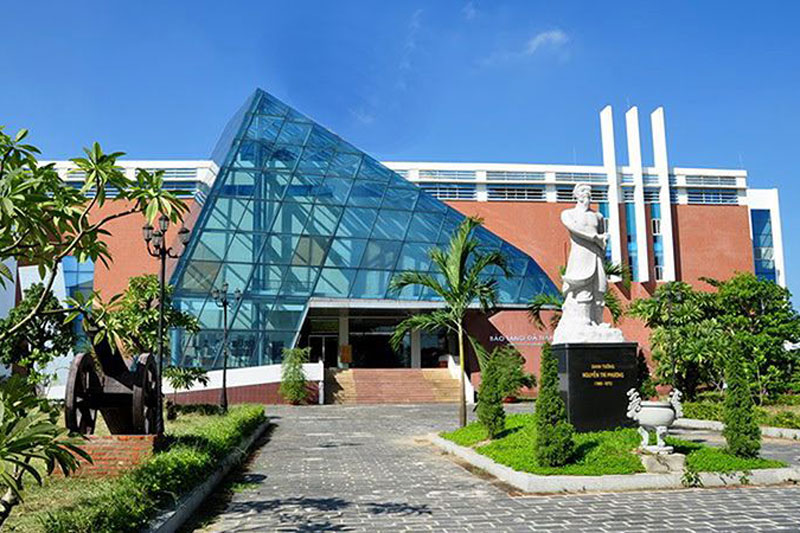
Da Nang Museum was founded in 1989 and was originally located in Le Duan Street. In 2005 it was relocated to 24 Tran Phu Street where it officially opened on 26 April 2011.

  • Address: 24 Tran Phu street, Hai Chau District, Da Nang
  • Price: 1 USD
  • Open time: Weekdays (Except Monday,  Morning: 7:30 – 11:30, Afternoon: 13:30 – 16:30
  • Visit duration: 01h00
  • Best time: Good for travel and first time visit
  • Price range: 1.00 USD
About:
Museum of Da Nang was founded in 1989 and was originally located in Le Duan Street. In 2005 it was relocated to 24 Tran Phu Street where it officially opened on 26 April 2011.
The new museum incorporates the reconstructed walls of a citadel built by Emperor Minh Mang at the beginning of the 19th century. The three-floor museum houses more than 2,500 photos and artifacts, more than 1,900 of which are original and have been collected from Da Nang and neighbouring areas since national reunification in 1975. Many are on public display for the first time.
As they enter the museum, visitors will be impressed by a large sail-shaped relief representing Da Nang’s founding history.
1. Applying fee for all organizations, individuals (domestic and international) visiting Bao Tang Danang
2. Free entrance fee for
  • Children, Students
  • Da Nang and Quang Nam Citizens– The Elders (from 60 years old) according to Elder Law– The disabled according to Disability Law– Diplomatic Guests
3. Entrance Fee: 20,000 VND/person
4. Applied from 01 June, 2015
5. Time: Weekdays (Except Monday)
  • Morning: 7:30 – 11:30
  • Afternoon: 13:30 – 16:30
What to explore:
The first floor displays Da Nang’s prehistoric times and its culture, the construction and development of the City, and the local traditional craft villages such as the Nam O fish sauce making village, Tuy Loan rice paper village and Non Nuoc stone carving village.
The second floor houses exhibits on war crimes and the aftermath of the various wars fought on Vietnamese soil, especially relating to the French and Americans in Da Nang.
The third floor showcases the cultural features of minority ethnic groups in the central region, especially Da Nang. Also on this floor is a 30-seat cinema where visitors can view documentaries on Da Nang’s history and culture.
da nang museum
How to get there:
  • From airport: 4 km away, go by motorbike or bicycle
  • From train station: 2 km away, go by motorbike or bicycle
  • From Hoi An ancient town: 30km away, go by taxi or bus
Reviews:
  • Insightful for Local Archaeology and History
  • An attraction not to be missed
  • Great surprise!!!
  • Interesting Perspective
  • Worth a visit

Da Nang Buddist Museum

Da Nang Travel and Shopping Guides recommend this for tourists

da nang buddist museum-

Da Nang Buddist Museum was located in 700 mile square of Avalokitesvara pagoda, Ngu Hanh Son District, Da Nang city which is a place currently stored hundreds of ancient artifacts about Buddhism and become a new destination in exploring Marble mountain since January 2016.

  • Address: Quan The Am Pagoda (Avalokitesvara) Pagoda (48 Su Van Hanh street, Ngu Hanh Son district)
  • Price: Free
  • Open time: 7h00 – 17h00
  • Visit duration: 01 hour
  • Best time: 9h00
  • Good for travel: First time visit
  • Price range: Free
What to explore:
Nowadays, the museum has been displaying over 200 artifacts that crystallizing the unique cultural values including Bodhisattva Guan Yin statue, Avalokiteshvara riding dragon and many parts of ancient statue such as Sakyamuni, Maitreya, Bodhisattva Kuan-yin, ChampaAvalokiteshvara, AmitabhaSakayamumi, bronze bell… Besides, the pagoda is currently stored many artifacts which are statues of Buddha, Buddha scripture, historic burners, worship things… dating from VII to the late XIX, XX century.
Da Nang Buddist Museum
One of the most exclusively unique artifacts which cannot be ignored in the displaying collection is Avalokiteshvara seating on an animal with dragon head and fish body, donated by local people when they accidentally got it while digging up few years ago. The status is about 50 m high, weighs 7 kilograms and was made by cast copper dating from the late 19th century. Now the museum is opened to the public with no fee in order to welcome tourist interested in Buddhist spirituality. Visiting the Marble mountains, visitors should take time to admire the collection which is exhibited in the first Buddhist museum of Vietnam.
How to get there:
You can come to Da Nang Buddist Museum by many ways including bus, motorbike, bike, taxi, car.
Reviews:
  • Unique values of Buddhist cultural heritage
  • The First Buddhist museum in Viet Nam

Da Nang Cathedral

Da Nang Travel and Shopping Guides recommend this for tourists

Da Nang Cathedral

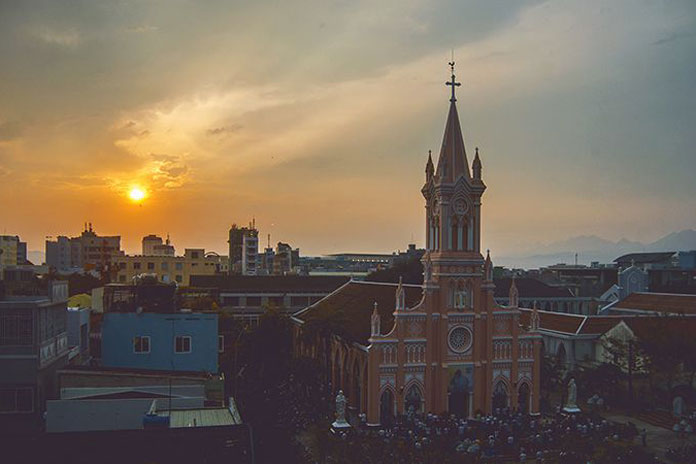
Da Nang Cathedral with nearly 70 meters high was built in 1923 by the priest Louis Vallet, it’s the only church built in Da Nang during the French colonial period.

  • Address: 156 Tran Phu street, Hai Chau district, Da Nang city
  • Price: Free
  • Open time: 07h00 – 19h00
  • Visit duration: 1/2 hour
  • Best time: 05h00
  • Good for travel: First time visit
  • Price range: Free
About:
Da Nang Cathedral is the cathedral of Da Nang Diocese in central Vietnam. This is the only church built in Da Nang city in the French colonial period.
The imposing, candy-pink cathedral is known locally by the slightly less imposing name ‘Rooster’ (Con Ga) Church. The name comes from the rooster that sits atop the impressive steeple.
According to an explanation from the priest, the rooster on the roof of the church is not in fact the symbol of France, but is a symbol associated with St Peter’s story in the Gospel about repentance and awakening.
Built in 1923 for Da Nang’s French colonial population, the cathedral is an easy half kilometer walk from the CBD. The church officially opened its doors on 10 March 1924 with the purpose of serving the French Catholics who lived in Da Nang at that time. Now, the cathedral still functions as a lively place of worship; in fact late-comers for services often find all the seats are taken.
Da Nang Cathedral
What to explore:
The church was designed with Gothic styles. Inside the church, there are holy pictures and statues illustrated the Bible events as motifs of Western churches. On the top roof of the church at the lightening rod position, there is with a statue of a gray rooster made of alloyed used to determine the directions of the winds.
The cathedral measures about 70 meters in height, and it’s Gothic-style design is an amazing and marvelous architectural structure incorporating several medieval stained glass windows of various saints. The Cathedral has been awarded a medal by the Vatican Holy See.
Behind the church is a grotto of the Blessed Virgin Mary, which is a replica of the Lourdes Grotto in France.
At present, the cathedral serves 4,000 parishioners, and offers services in different languages with sermons in English every Sunday at 9am. Late-comers for services often find all the seats are taken.
The Da Nang Cathedral is a wonderful religious site, well worth a visit whilst you are discovering the beauty of the land and people of our seaside city.
How to get there:
Danang does not have the volume of traffic like other large cities so taxis are cheap to access and tour round Da Nang and find the attractions.
Reviews:
  • Bigger than it looks
  • Grand Catherdral of Da Nang
  • Coold Old Church
  • Beautifil outlook
  • Lovely pink Cathedral

Linh Ung Pagoda

Da Nang Travel and Shopping Guides recommend this for tourists

linh ung pagoda in da nang

Son Tra Linh Ung Pagoda leaning against the top of Son Tra peninsula is considered the largest pagoda in Da Nang city in both scale and architectural art. The main Shrine has the large capacity where is the most dignified and tranquil place.

  • Address: In the upper area of Buddha stream, Son Tra Peninsula, Tho Quang Ward, Son Tra District.
  • Price: Free
  • Open time: All day
  • Visit duration: 01h00
  • Best time: 05h00
  • Good for travel: First time visit, Second time visit
About:
Linh Ung pagoda is the largest pagoda of scale and artistic architecture. It is so famous for the huge statue of Lady Buddha – 67m high.
Considered as the largest pagoda by its scale and artistic architecture in Danang city, Linh Ung pagoda with the highest statue of Lady Buddha ( actually Lady Bodhisattva) in Vietnam created a wonderful place where visitors can free their mind by enjoying boundless ocean, beautiful and lively coastal road.
Linh Ung – Bai But pagoda features perfect harmony between the modern and traditional architectures of Vietnamese pagodas, especially in the three-entrance gate, the main chamber and the ancestors’ house.
The local people here believed that the statue of Lady Buddha or Goddess of Mercy not only protect the fisherman but also offering them strength for facing storms and strong waves.
linh ung pagoda in da nang
What to explore:
On the way to see Linh Ung pagoda, you will pass a giant 3 doors gate, then you will surprise how spectacular it is.
Just behind the entrance gate, there is a lovely courtyard with different kind of bonsai trees and 18 statues of aghast showing their expression. It is such a good place for your photos
If you want to see more about Buddhism, you can go into the main building of this pagoda, discover many statues of different Buddha, Bodhisattva and arhats and a set of sculptural relief describing about the life of Shakyamuni
By walking to the statue, you may get stunned by the 67m high spectacular statue. Enjoy the view of the ocean, and the coastal stripe of Danang are the wonderful things that you can do here.
Just near the statue, there are steps down to a balcony where you can completely see the wonderful view.
It is more delightful if you can go to this place at night, from 6-8 pm when you can see the endless light stripe from Danang to Hoian and many fishing boats catching seafood.
How to get there:
Because this pagoda is located on a peninsula, so there is no bus stop or train station nearby. The only way to go there are by car, motorbike, bike, taxi.
By car: If you book a car or a taxi, that will be easy, and most of the taxi drivers will know there and take you to the pagoda fast. It’s about 200.000 VND from the Da Nang Airport to Linh Ung pagoda.
By motorbike: In case you want to go to that place by yourself, so just go to My Khe beach on Vo Nguyen Giap street first ( you even see the statue from there) then turn left ( if you turn right, you will go to Hoian), go straight along the beach ( about 8km) and turn right to the mountain side, then you just keep going about 1.5km further, finally you can see the entrance to the pagoda, following 200m windy road to the parking lot, then you can walk to the statue ( for parking there, the fee is up to you, just put money into the donation box )
If you want to ride your bike from Hoi An, so go to the traffic light near An Bang beach first, then turn left, keep riding about 20 km along the beach to see My Khe beach, then follow the way described above.
Reviews:
  • Calming atmosphere with stunning views
  • Peacefull hilltop setting
  • Impressived and relaxing place
  • Stuning ocean and moutain view
  • Breathtaking view of Danang from the top
Travel tips:
  • There are many steps to the gate, so if you don’t want to walk a lot, it is better that you ask the driver to stop at the hilltop parking.
  • You need bring good camera and tripod to capture the beautiful sights. Taking panoramic photos here is great idea.
  • It is quite hot at the mid day, so you should bring umbrella and water.
  • You should take your shoes off at door of the main temple.
  • You should see it at night, when it is cooler and the incredible view of all the lights of the city.